
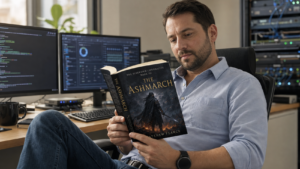
Information technology professionals spend their days keeping a digital world from falling apart. They solve problems that arrive without warning, trace failures through layers of interconnected systems, protect valuable data, and explain technical emergencies to people who simply want everything working again. By the end of the day, another screen rarely feels like an escape.
That is where an immersive fantasy novel can work its magic. The Sinsworn Chronicles, Book III: The Ashmarch by Matthew Pearce leads readers away from notifications, support tickets, security alerts, and project deadlines into a ruined land shaped by ancient corruption. It offers danger, mystery, survival, and buried history without resembling another day inside a server room.
For IT professionals who enjoy complex systems, hidden causes, formidable threats, and characters forced to make difficult decisions with incomplete information, The Ashmarch feels unexpectedly familiar. The setting may be fantastical, but its underlying tensions reflect challenges that technology professionals confront every day. ⚔️
IT Professionals Live in a World of Constant Change
The technology industry never stays still. New platforms emerge, security risks evolve, artificial intelligence changes familiar workflows, and yesterday’s reliable solution becomes tomorrow’s legacy system. ACM TechNews publishes timely developments for computing professionals several times each week, illustrating just how quickly the field moves.
That pace creates opportunity, but it also produces fatigue. IT professionals are expected to keep learning while maintaining systems that cannot pause for their education. A network administrator may need to investigate an outage while answering messages from several departments. A cybersecurity analyst may spend hours reviewing suspicious activity that turns out to be harmless. A developer may repair one bug only to discover that the fix exposed three older problems.
The Ashmarch replaces technical uncertainty with mythic uncertainty. Serenya and the Sinsworn enter a ruined expanse where the land bears the scars of ancient corruption. Birds refuse to cross its sky, maps cannot reliably contain its shape, and ash conceals forgotten graves and forbidden history. The landscape behaves like a system whose rules have been damaged, hidden, or deliberately rewritten.
For someone accustomed to diagnosing unstable environments, that premise has an immediate pull. Every visible symptom suggests a deeper cause, and every discovery threatens to change the characters’ understanding of the world.
A Story Built Around the Appeal of Troubleshooting
Troubleshooting begins with evidence. Something has failed, but the first explanation is rarely the complete one. IT professionals gather logs, reproduce errors, isolate variables, and follow small clues until an underlying cause emerges.
The Ashmarch creates a similar sense of investigation. The fire has revealed part of the truth, but survival depends on understanding what comes afterward. Old wounds resurface. Hidden truths emerge. The land itself contains evidence of events that powerful forces would rather leave buried.
This structure appeals to readers who enjoy discovering how separate pieces fit together. The mystery is larger than a single enemy or isolated conflict. History, personal damage, corruption, and present danger interact like components inside a complicated architecture.
The modern definition of information technology covers the systems used to create, process, store, retrieve, and transmit information. Inside the Ashmarch, information is equally valuable, though it takes the form of suppressed history, unreliable geography, old scars, and truths waiting beneath the ash. Knowledge can save lives, but uncovering it can also awaken dangers.
That tension gives the story intellectual weight without turning it into a technical exercise. Readers receive the satisfaction of following clues while remaining fully immersed in a dark fantasy adventure.
The Ashmarch Understands High-Stakes Responsibility
People outside IT often notice technology only when it stops working. They rarely see the maintenance, planning, testing, monitoring, and defensive work that prevents failure. The responsibility can be enormous, especially when a small mistake affects an entire organization.
The U.S. Bureau of Labor Statistics describes computer and information technology professionals as the people who create or support applications, systems, and networks. That short description covers an immense range of responsibilities. It includes protecting operations, preserving access, supporting users, and making decisions that may influence thousands of people.
Serenya and the Sinsworn also carry burdens larger than themselves. They are not wandering through a harmless wilderness in search of novelty. They are moving through the aftermath of the Forbidden Flame while something hunts them and something deeper begins to wake.
Their decisions matter because failure has consequences. The group must move forward despite uncertainty, personal wounds, and dangers they do not fully understand. IT professionals know this pressure in a different form. During a serious outage or security event, perfect information rarely arrives before action becomes necessary. Someone must evaluate the evidence, choose a path, and accept responsibility for the result.
That shared emotional reality helps the characters’ struggles land with greater force.
Ancient Corruption Feels Strangely Familiar
Cybersecurity has made hidden threats part of everyday professional life. Malicious activity may remain concealed inside a network, waiting for the right moment to surface. A compromised account can look ordinary. An overlooked vulnerability can remain harmless for months before becoming the doorway to a much larger incident.
The Cybersecurity and Infrastructure Security Agency tracks evolving threats and provides information intended to help organizations defend critical systems. Its work reflects a reality familiar to every security-conscious IT professional: visible damage may be only the outer edge of a deeper problem.
The corruption within the Ashmarch carries a comparable sense of concealed danger. The land has been altered by forces whose effects remain present long after the original events. The past is not safely contained. It has shaped the terrain, silenced the sky, distorted maps, and buried truths beneath layers of ash.
This makes the setting feel active rather than decorative. The environment holds memory. Damage has propagated through it. Readers sense that every quiet place may conceal another consequence.
IT professionals often inherit systems built by people they will never meet. They encounter undocumented decisions, obsolete dependencies, improvised fixes, and structural weaknesses that have survived for years. The Ashmarch operates on a grander and more sinister scale, but its buried history creates the same compelling need to understand what happened before attempting to repair what remains. 🔥
The Characters Carry Damage That Cannot Be Patched Away
Technical professionals are trained to search for solutions. Many problems can be fixed through patience, knowledge, and careful work. Human damage follows different rules.
The Sinsworn must confront both the darkness hunting them and the damage carried within themselves. That distinction gives the story emotional substance. External danger may force the group to act, but internal wounds shape how each person responds.
A character cannot simply remove grief, guilt, fear, or mistrust and install a cleaner version. Recovery requires honesty, endurance, and the willingness to depend on others. These struggles make the fantasy feel personal even when the surrounding conflict becomes enormous.
The technology sector increasingly recognizes that professional resilience involves more than technical ability. IEEE Spectrum covers developments across computing, engineering, science, and professional life, showing how human judgment remains central even as technology becomes more capable.
That human dimension matters in The Ashmarch. Its characters are compelling because they carry history into every decision. Their strengths do not erase their wounds, and their wounds do not eliminate their ability to keep moving.
A Strong Escape for a Profession That Rarely Switches Off
Many IT professionals remain mentally connected to work after leaving their desks. An unresolved error continues running through the mind. A late-night notification may signal a routine update or the beginning of a serious incident. On-call responsibilities can turn a quiet evening into an emergency shift.
Cybersecurity guidance from the National Institute of Standards and Technology demonstrates the continuous attention required to keep pace with new publications, risks, events, and standards. Even valuable professional information adds to the volume that technology workers are expected to process.
Reading fantasy offers a different kind of concentration. It invites the mind to focus without asking it to perform. The reader can follow a dangerous journey, interpret mysteries, and experience suspense without being responsible for the outcome.
Among the top epic fantasy books for readers who work in technology, The Ashmarch stands out because it provides genuine distance from the office while respecting the kind of intelligence that IT work develops. Its mystery rewards attention. Its damaged world encourages analysis. Its dangers build tension without resembling another crowded project dashboard.
The book offers a mental shift from solving problems to experiencing a story. That difference can make an evening of reading feel restorative rather than merely distracting.
Teamwork Matters in Every Difficult Environment
Major IT projects rarely succeed through individual effort alone. Developers, administrators, analysts, engineers, support specialists, managers, vendors, and users all hold different pieces of the larger picture. Communication gaps can create problems as serious as technical failures.
The Sinsworn face a world in which isolation increases danger. Survival requires cooperation among people carrying their own fears, knowledge, loyalties, and wounds. Trust becomes a practical resource.
This aspect of the story resonates with anyone who has worked through a difficult migration, investigated a widespread outage, or responded to an urgent security event. The strongest person in the room cannot perform every role. Progress depends on individuals sharing what they know and relying on the abilities of others.
The growing importance of these roles is reflected in federal employment projections. The Bureau of Labor Statistics reported in its 2026 overview of artificial intelligence, information technology, and employment that several technology-related occupations are expected to experience substantial growth through 2034. More systems, more data, and more automation still create a need for people who can think clearly and work effectively together.
The Ashmarch places that principle inside a harsher world. Cooperation is not a corporate value printed on a wall. It is part of staying alive.
A Dark Fantasy World Worth Entering
The Ashmarch is memorable because it feels scarred, secretive, and dangerous. Its silence creates tension. Its ash hides history. Its shifting geography prevents certainty. Vaelor follows, the Ashmarch waits, and something beneath the silence begins to wake.
These elements give IT professionals something they rarely receive during the workday: mystery that does not need to be resolved before a deadline. Readers can enter an unpredictable environment without carrying operational responsibility for it.
The novel also delivers a welcome contrast to digital life. Software is designed around menus, notifications, dashboards, and measurable actions. The Ashmarch is wild, ancient, and resistant to control. Its mysteries cannot be reduced to a status panel. Its history refuses to remain archived.
That contrast makes the journey more immersive. A reader who has spent all day navigating artificial systems can step into a place governed by old power, damaged memory, and dangerous truth. 🐉
Conclusion
The Sinsworn Chronicles, Book III: The Ashmarch speaks to IT professionals because it transforms familiar pressures into epic fantasy. Unstable systems become corrupted landscapes. Hidden vulnerabilities become buried evils. Incomplete documentation becomes forbidden history. Team coordination becomes a struggle for survival.
The novel offers complexity without another work assignment and mystery without another ticket waiting for resolution. Serenya and the Sinsworn move through a land that refuses to behave predictably, carrying personal damage while confronting a threat larger than any one of them.
For technology professionals exhausted by bugs, deadlines, alerts, and constant change, The Ashmarch provides the right kind of escape. It respects the reader’s appetite for intricate problems while replacing fluorescent offices and glowing screens with ash, ancient secrets, gathering darkness, and a world that has been waiting to reveal what lies beneath.